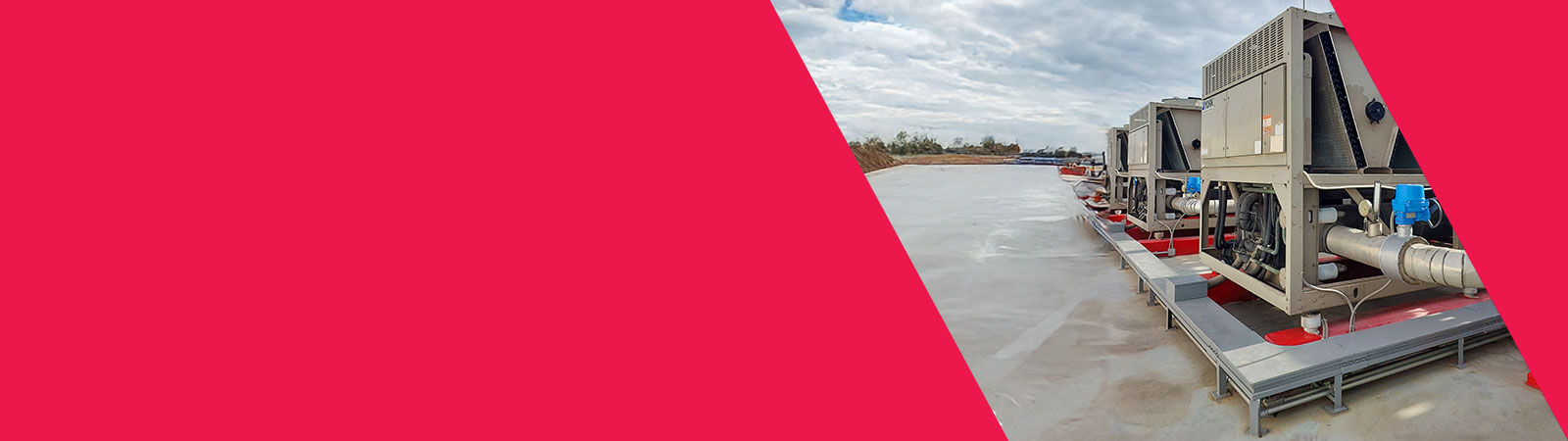
Chillers Bring a Much Needed Debate to HVAC Performance
With today’s intense manufacturing processes and information technology requirements, it is essential to have the appropriate HVAC component systems for these environments — enter air-cooled and water-cooled chillers. Triangle Contractors understands the complexities that come with selecting and installing the appropriate chiller system depending on the application, environmental conditions, and operational goals of the client.
During its nearly 50-year history, Triangle Contractors has adapted to the changing design and technology of air-cooled and water-cooled chillers. While similar in purpose, both chiller types have advantages and ideal applications — let’s take a closer look and determine how and where we can serve your chiller needs.
The Difference in Chillers
Defining Chillers, Identifying Differences
Chillers are essential HVAC components for many industrial, commercial, and even multi-family residential cooling systems and function to absorb heat from a space or process and dissipate it into the outside environment. The difference between air-cooled and water-cooled chillers is how each dissipates absorbed heat.
During its nearly 50-year history, Triangle Contractors has adapted to the changing design and technology of air-cooled and water-cooled chillers. While similar in purpose, both chiller types have advantages and ideal applications — let’s take a closer look and determine how and where we can serve your chiller needs.
- Air-cooled chillers use ambient air to cool and condense the refrigerant, which absorbs heat from the process fluid. Fans then blow air over a coil containing the heated refrigerant, transferring the heat to the air.
- Water-cooled chillers use water from a cooling tower to condense the refrigerant, absorbing heat from the process fluid. Water from the cooling tower circulates through the heat exchanger, where it absorbs the heat from the refrigerant and releases it into the atmosphere through evaporation in the cooling tower.
Other key differences between air-cooled and water-cooled chillers include the following:
Installation and maintenance. Water-cooled chillers are more complex to install than air-cooled chillers because they require a cooling tower, condenser water pump, and water treatment system, among other components, leading to higher upfront costs. A larger footprint is also required for water-cooled chillers, making them less ideal in urban areas or facilities with space constraints. As expected, maintenance of water-cooled systems is more rigorous due to component complexities, such as cooling tower servicing and water quality checks. However, Triangle Contractors does provide maintenance services for all water-cooled and air-cooled chillers.
Environmental considerations. Because air-cooled chillers don’t require water to operate, it eliminates the need for chemical treatments. However, in hotter climates, air cooled chillers must work harder to dissipate heat, driving energy consumption. Conversely, water-cooled chillers are more energy efficient and reduce energy consumption when compared to air-cooled chillers. However, the significant demand for water consumption makes water-cooled chillers unsuitable in areas where water scarcity exists. Typically, this isn’t an issue for North Carolina businesses, but it is a consideration.
Operational longevity. Without the requirement of a constant water supply, air-cooled chillers are less dependent on ambient conditions — leading to less intensive maintenance requirements and a longer service life. Water-cooled chillers benefit from a cooling tower that dissipates heat more effectively in warmer climates while providing precise temperature control. The lifespan of a water-cooled chiller largely depends on adherence to regular maintenance of water systems.
Efficiency and performance. Due to the lower heat capacity of air compared to water, air-cooled chillers are less efficient than water-cooled chillers. Thus, more energy is consumed (particularly in high ambient temperature environments) to achieve the same cooling output of water-cooled systems. A higher heat capacity allows water-cooled chillers to absorb and dissipate more heat, resulting in lower energy consumption. The cooling tower enables more temperature control and greater energy efficiency — an ideal combination for large-scale industrial facilities.


What kind of Cool do you need?
Optimal Chiller Applications
Various industries rely on air-cooled and water-cooled chillers for maintaining temperature control for processes, equipment, and environments. With the best-suited chiller, companies can optimize operational performance while reducing costs by gaining energy efficiencies. Thus, the choice of air-cooled or water-cooled chiller comes down to the application itself coupled with the environmental conditions and operational requirements.
In what applications are air-cooled and water-cooled chillers most prevalent? A breakdown of application areas demonstrates the diverse industries and environments where these chillers are delivering value and long-term reliability.
Due to potential space constraints and lower maintenance costs, an air-cooled chiller is most commonly found in commercial and multi-family residential buildings, but also small- to medium-sized industry facilities and data and IT centers.
Commercial buildings
Commercial buildings. Urban areas are ideal for air-cooled chillers where water tower installations are impractical. Most office complexes and retail stores experience moderate cooling loads, making air-cooled chillers an effective choice.
Residential complexes
Residential complexes. On the residential side, multi-story apartment and condominium buildings present similar cooling tower installation challenges where lower maintenance needs are more desirable. Also, operational demands in a residential setting are considerably lower than industrial applications.
Small and medium-sized facilities
Small- and medium-sized facilities. The energy load for process cooling in smaller manufacturing environments is much lower than larger facilities. An air-cooler chiller can prevent overheating machinery, while maintaining comfortable working conditions for employees. Cost effectiveness is a critical factor across all applications of air-cooled chillers and has a significant impact on operational and energy expenses.
Data and IT Centers
Data and IT centers. The ability to control a consistent temperature for buildings housing numerous servers and mainframes is crucial for their optimal performance. Depending on environmental constraints, air-cooled chillers are ideal where water availability is scarce. Water management can lead to higher maintenance costs for smaller to mid-sized data centers.
Conversely, water-cooled chillers benefit large commercial facilities, healthcare centers, industrial plants, and district cooling areas. Unique operating requirements combined with heavier cooling loads is why water-cooled chillers deliver greater performance and value for these customers.
Large Commercial buildings
Large commercial buildings. Whether it’s immense warehouses or high-rise office buildings and hotels, water-cooled chillers have the capacity to process substantial cooling loads for greater efficiency. When integrated with central HVAC systems, large-scale applications can achieve lower operating costs.
Healthcare facilities
Healthcare facilities. In healthcare environments, such as hospitals, where precise temperature control can be a life-or-death element, water-cooled chillers are a necessity. Patient comfort, sterile conditions like operating rooms and laboratories, and equipment performance all depend on optimal temperature control.
Industrial facilities
Industrial facilities. Similar to healthcare requirements, industrial facilities like pharmaceutical/chemical plants or food and beverage processing facilities emit immense heat during production processes. Water-cooled chillers manage the extensive cooling and temperature control within reactors and distillation columns. In food and beverage, quality and safety are maintained by controlled temperatures during production processes like pasteurization and fermentation, and refrigeration during storage.
District cooling
District cooling. When a centralized water-cooled chiller unit cools multiple buildings in an area (e.g., residential, commercial, and industrial), it is known as district cooling. Through centralized cooling management, customers can achieve economies of scale and reduced energy consumption across area facilities.
Call in the PROs at Triangle Contractors to Determine Which Type of Chiller is Best for Your Application
Ultimately, the choice between air-cooled or water-cooled chillers depends on factors such as the size of the application, environmental conditions, available resources, and long-term operational goals. Triangle
Contractors can help facility managers or engineers select and install the most appropriate chiller system to meet their needs, ensuring optimal HVAC performance and cost effectiveness.